


We often see the beautiful open palm and the striking blue eye together in jewelry and home decor. Many people wonder if these two symbols serve the exact same purpose or if they have distinct spiritual roles. As cultural researchers, we see these icons as more than just fashion trends; they are ancient tools for the soul. The human spirit has always felt an intrinsic need for protection against the unseen forces of envy and bad luck. In our modern world, these symbols have transitioned from ancient talismans to essential tools for spiritual shielding in a digital age. Understanding the “Sacred Geometry” of defense helps us navigate life with more confidence and peace. We are here to help you decode the deep mysteries behind these two powerful protectors.
Quick Answer: The Hamsa is an “Active Shield” that invites divine blessing and providence into your life. The Evil Eye is a “Passive Deflector” (Nazar) designed specifically to neutralize malevolent glares born of envy. While they have different functions, they are often combined to create a comprehensive vibrational boundary for the wearer.
Ancient Origins and Sacred Lore: The Cradle of Protection
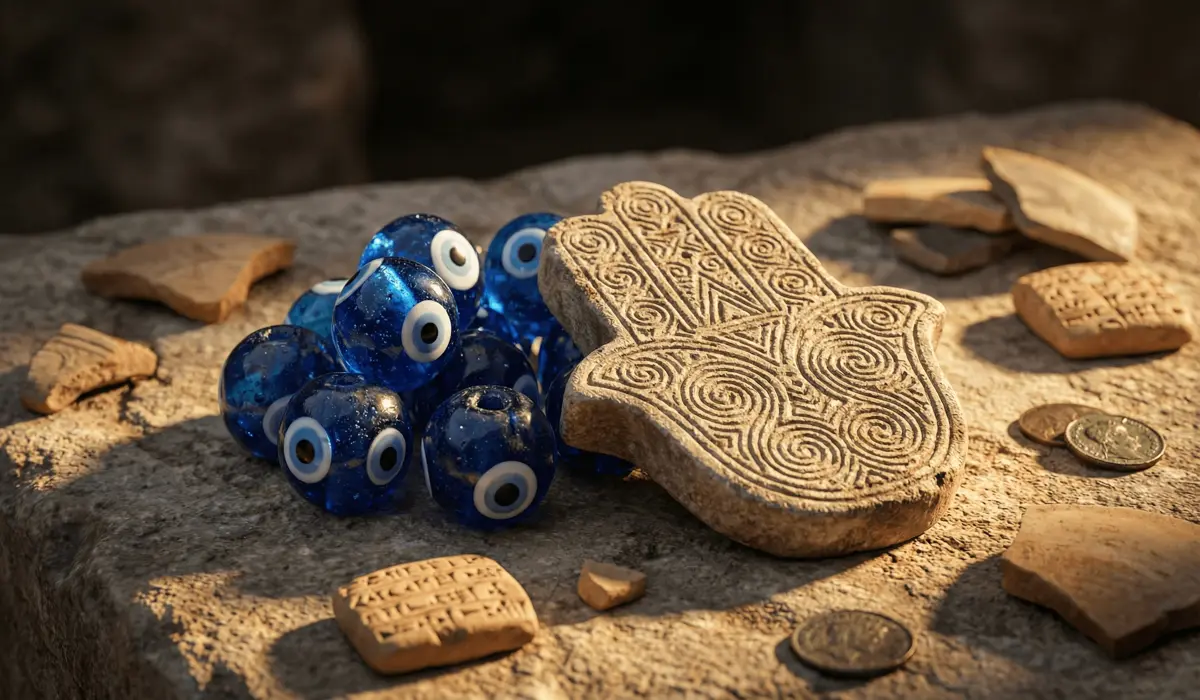
The history of these symbols takes us back thousands of years to the Middle Eastern (Judaism, Islam) lands and the Mediterranean. The Evil Eye, often called the “Mati,” originates from an ancient Sumerian belief. People believed that a malevolent glare born of extreme envy could physically wither the soul of the victim. This “Envious Gaze” (Ayin Hara) was feared across Mesopotamia as a source of sudden misfortune or illness. To fight this, the “Nazar Boncuk” evolved from ancient cuneiform descriptions into the iconic blue glass charms we see today. These charms were created to “stare back” at the evil energy and shatter its power before it could cause any harm.
The Hamsa has a similarly deep lineage that traces back to ancient Carthage and the Phoenician goddess Tanit. It predates many major monotheistic religions and was widely used across the Levant as a sign of divine protection. Known as the “Hand of God,” it represents a gesture of defense that stops negativity in its tracks. In different cultures, it is called the “Hand of Fatima” or the “Hand of Miriam,” showing its broad appeal across many faiths. Both symbols were part of a rich tradition of apotropaic magic, which is the practice of using symbols to turn away evil. This ancient wisdom traveled through the Silk Road, influencing cultures from Egypt to the far reaches of Europe.
The Mesopotamian Roots of the Evil Eye
Ancient texts from the Sumerian era describe the “Mati” as a force that could dry up wells and cause livestock to fall ill. The early residents of the Mediterranean used blue glass because the color was rare and believed to have celestial powers. This tradition turned into a sophisticated system of folk magic that still exists in modern Greek and Turkish societies. Using a Encyclopaedia Britannica search will reveal how these blue beads became the primary tool for gaze-based protection.
The Core Difference: Active Blessing vs. Passive Deflection
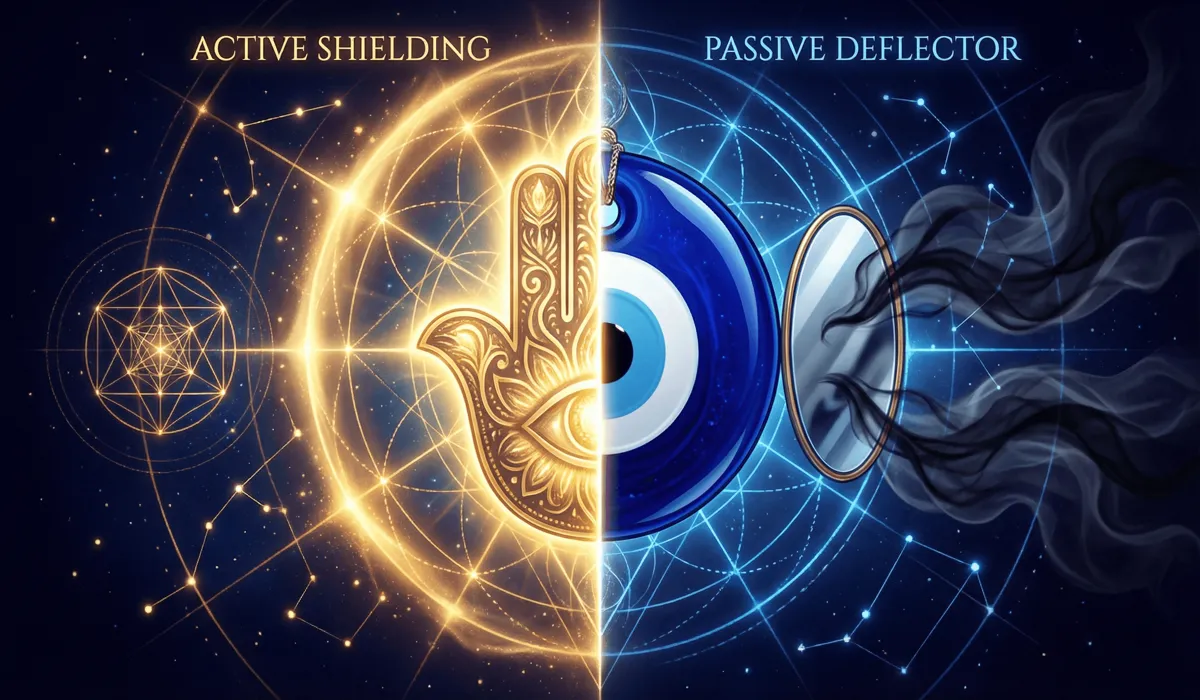
To truly understand “Hamsa vs. Evil Eye: What is the Difference?”, we must look at their core philosophies. The Hamsa is what we call an “Active Shield” because it does two things at once. It physically blocks negative energy with its palm while its fingers invite luck, health, and happiness. It acts like a magnet for good vibrations, ensuring that the wearer stays connected to divine providence. When you wear a Hamsa, you are not just hiding; you are actively calling for spiritual support and strength.
The Evil Eye functions as a “Passive Deflector” that works through a mirror-like logic. It does not necessarily bring you “luck” in the traditional sense; instead, it prevents “bad luck” from reaching you. The “Blue Glass Nazar” is designed to absorb and shatter negative frequencies emitted by jealous people. If the charm breaks, it means it has done its job by taking the hit for you. This distinction is vital for anyone looking to build a balanced spiritual practice in their daily life.
There are several key differences in how these symbols interact with your personal energy field:
- The Hamsa brings feminine energy and strength, often associated with the “Hand of Fatima” or “Hand of Miriam.”
- The Evil Eye specifically targets the “Ayin Hara” or the negative effects of the envious gaze.
- Hamsa symbols often include a “Central Eye” to combine gaze neutralization with divine providence.
- The Nazar is almost always blue, whereas the Hamsa can be made of various metals and stones.
- Hamsas can point up or down to change the type of energy they attract or repel.
By using both together, you create a dual-frequency boundary that protects your spirit from all angles.
Cultural Lenses: The Hand of Fatima, Miriam, and Mary
In Islamic traditions, the Hamsa is the “Hand of Fatima,” named after the daughter of the Prophet Muhammad. It stands for the five pillars of Islam and serves as a symbol of faith, patience, and protection against the unseen. In Jewish culture, it is the “Hand of Miriam,” representing the five books of the Torah and the power of the divine. Kabbalah practitioners often use the “Sacred Palm” to combat the “Ayin Hara” and protect their families from jealousy. Even in some Christian traditions, it is associated with the “Hand of Mary,” showing the universal human desire for a mother’s protection.
These cultural interpretations all point toward the same truth: the hand is a universal “Gesture of Defense.” We see this same energy in the “Abhaya Mudra” found in Buddhist and Hindu traditions, which signals fearlessness. Studying Spiritual Symbols helps us see the threads that connect all of these different civilizations. Whether you call it Khamsa or Mati, the goal remains the same—to find peace in a chaotic world. This shared heritage makes these symbols a bridge between different faiths and a powerful reminder of our common humanity.
Directional Meaning: Why Upward and Downward Hamsas Matter
Many people do not realize that the direction the Hamsa points completely changes its spiritual “signal.” When the fingers point upward, the Hamsa is a powerful “stop” sign to the world. It acts as a shield against the negativity of others and helps you set firm boundaries. This upward position is best when you feel overwhelmed by external pressure or “Energy Vampires.” It tells the universe that you are protected and that no harm shall pass through your personal space.
The Directional Rule: Fingers pointing up create a barrier against the outside world, focusing on “Protection.” Fingers pointing down represent an “Open Vessel” for receiving blessings, luck, and abundance from the divine.
When the fingers point downward, the Hamsa becomes a gesture of welcome and manifestation. This position is associated with the “Abundance Blessing” and is often used to invite wealth and success. If you are starting a new project or looking for personal growth, a downward-facing Hamsa is the perfect choice. It symbolizes the divine hand reaching down to offer grace and support to the wearer. Understanding this subtle difference allows you to choose the right talisman for your specific needs at any given time.
Modern Relevance: Deflecting Digital Envy in 2026
In our modern world, the “Evil Eye” has moved from village squares to social media platforms. We now face what we call “Digital Envy,” where thousands of people may view our lives through a screen. This constant exposure can create a vibrational drain, making us feel anxious or ungrounded without knowing why. Wearing a Hamsa or Evil Eye charm in 2026 acts as a “Vibrational Boundary” against this online negativity. It helps you stay centered and prevents the “Digital Evil Eye” from affecting your mental health or self-esteem.

We believe that “Intentional Jewelry” is more important now than ever before. These symbols serve as physical touchstones that remind us to stay present and mindful. When you touch your Hamsa pendant, it can act as a “Mindfulness Anchor,” helping you reset your energy after a stressful interaction. Many people find that wearing these symbols reduces the social anxiety caused by the “Envious Gaze” of others. It is not about superstition; it is about using ancient wisdom to manage the energy of a high-tech society. For those looking to understand the specific energies of the coming years, a guide to 2026 Fire Horse Guide can be a valuable resource.
The Color Alchemy of the Nazar: Why Blue is the Global Shield
The color blue is the defining feature of the “Nazar Boncuk” for a very specific scientific and spiritual reason. Blue sits at a high frequency on the light spectrum, and in many cultures, it is the color of the sky and the heavens. It was believed that blue glass could absorb the “heat” of a malevolent gaze and cool it down. This “Color Alchemy” is why you will rarely see a traditional Evil Eye charm in red or yellow. The blue spectrum is thought to be the most effective at neutralizing high-frequency “Digital Envy” and jealousy.
The physical composition of the charm is also significant in Mediterranean folklore. Authentic charms are made of hand-blown glass, which is fragile by design. This fragility is a feature, not a bug; the glass is meant to shatter when it has absorbed too much negativity. If your blue eye charm breaks, do not be afraid; it simply means it has fulfilled its purpose as a “Passive Deflector.” This ancient technology for the soul is still remarkably effective at helping people feel safe and secure. You can find more details about this tradition on Wikipedia while researching Mediterranean history.
Synergy in Jewelry: Why the Hamsa and Evil Eye are Often Paired
While they are different, we often recommend wearing the Hamsa and the Evil Eye together. This combination creates a “layered protection” system that covers both active and passive defense. The Hamsa brings in the positive vibes and divine favor, while the Evil Eye watches your back and deflects jealousy. It is like having both a sturdy wall (Hamsa) and a high-tech security camera (Evil Eye) for your spirit. This synergy is why you see so many designers merging the two into a single piece of jewelry.
To help you understand how these two symbols compare, we have prepared a detailed comparison table:
| Feature | Hamsa Hand (Sacred Palm) | Evil Eye (Nazar) |
|---|---|---|
| Primary Role | Active Shield & Blessing | Passive Deflector |
| Philosophy | Divine Providence | Envy Neutralization |
| Energy Type | Feminine / Strengthening | Protective / Reflective |
| Color Theme | Various (Gold, Silver, Stones) | Cobalt Blue / Turquoise |
| Common Use | Attracting Luck & Abundance | Repelling Jealousy & Malice |
Wearing these together allows you to feel completely “covered” in any social or spiritual situation. This is especially useful for those who work in high-stress environments or public-facing roles where envy is common. You can browse our Hamsa Jewelry Collection to see how these elements are artistically combined. Having a physical reminder of your inner strength can significantly boost your confidence and mental clarity.
Placement Guide: Protecting Your Sanctuary and Home Entrances
The placement of these symbols in your home is just as important as how you wear them. In many Mediterranean cultures, a large blue Nazar is placed near the front door to “catch” the eyes of visitors. The idea is that any negative energy or jealousy brought into the home is neutralized before it crosses the threshold. This keeps your living space a pure and peaceful sanctuary for your family. For a modern “smart home,” placing a small blue glass charm on a console table near the entrance is a subtle and effective choice.
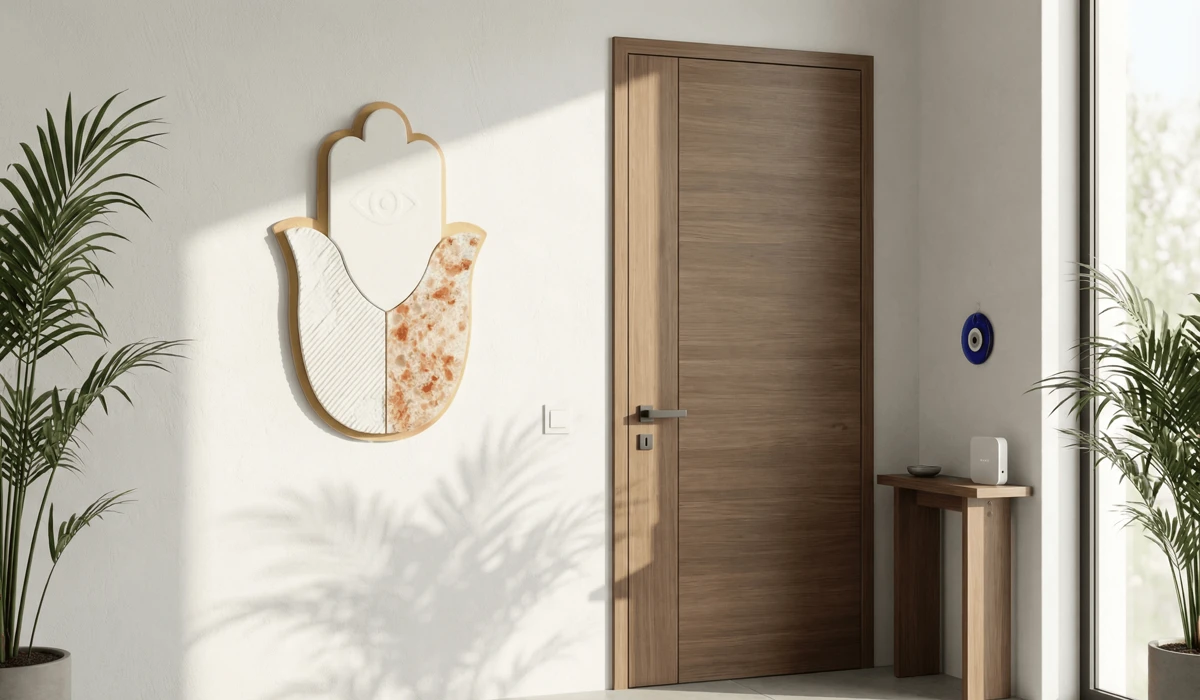
A Hamsa wall hanging is perfect for the main living area or the kitchen, where family members gather. We recommend hanging it with the fingers pointing down to invite an “Abundance Blessing” into the heart of the home. This placement helps maintain a high-vibrational atmosphere and promotes harmony among those who live there. If you follow modern design principles, look for artisan-crafted ceramic or metal versions that blend with your decor. For more advice on home energy, you can consult the Feng Shui Society website for professional tips.
How to Meditate with the Hamsa for Emotional Boundary Setting
You can use the Hamsa as a focus point for your daily meditation or mindfulness practice. Hold your talisman in your hand and visualize a radiant, golden light emanating from the palm. Imagine this light creating a “Sacred Palm” barrier around your entire body, keeping you safe from external negativity. As you breathe in, imagine you are drawing in the “Divine Providence” and strength that the symbol represents. As you breathe out, visualize any lingering envy or stress leaving your energy field and dissolving into the light.
Mindful Visualization: When using an Evil Eye charm during meditation, visualize it as a mirror that reflects any negative thoughts back into the void. This helps you clear “Self-Inflicted Negativity” as well as external envy.
This simple practice can help you set emotional boundaries before you start your day or enter a difficult meeting. It turns a piece of jewelry into a functional tool for your mental and spiritual well-being. By combining visualization with the physical symbol, you reinforce the “Vibrational Boundary” in your mind. Over time, you will find it easier to stay centered even when the world around you feels chaotic. This is the true power of ancient symbols in the modern world.
Actionable Steps for Spiritual Integration
If you are ready to bring these symbols into your daily life, follow these simple steps:
- Select Your Intent: Choose a Hamsa for active blessing or an Evil Eye for passive protection based on your current needs.
- Set a Daily Intention: When you put on your jewelry, state a simple phrase like “I am protected and open to abundance.”
- Place Symbols Strategically: Put a Nazar near your home entrance and a Hamsa in your workspace to balance the energy of your environments.
- Cleanse Regularly: Use moonlight, salt, or sound frequency to reset the vibration of your talismans once a month.
Following these steps will help you maximize the benefits of these ancient protective tools.
Frequently Asked Questions (FAQ)
Q: What is the difference between an active blessing and a passive deflection?
A: An active blessing, like the Hamsa, actively invites positive energy, luck, and divine support into your life. It works to improve your situation while protecting it. A passive deflection, like the Evil Eye, focuses solely on repelling and neutralizing external negative energy or jealousy. It acts as a shield that prevents harm rather than a magnet for good luck.
Q: Can the Hamsa hand and the Evil Eye be worn simultaneously for layered protection?
A: Yes, they are frequently worn together to create a dual-frequency boundary. The Hamsa provides the strength and blessings of the “Active Shield,” while the Evil Eye provides the “Passive Deflector” to stop envy. This combination is considered the most comprehensive way to protect your spirit from multiple angles of negativity.
Q: Why is the blue color significant in Evil Eye talismans for 2026 digital shielding?
A: The color blue has a high spiritual frequency that has been used for thousands of years to “cool” and neutralize the “heat” of an envious gaze. In the context of 2026 digital life, this frequency helps shield the user from the high-speed “Digital Envy” found on social media. It acts as a vibrational filter for the information age.
Q: What is the symbolic meaning of the Hamsa fingers pointing up vs. pointing down?
A: When the fingers point up, the Hamsa is a “stop” sign that creates a protective barrier against the outside world. When the fingers point down, it represents an open vessel that is ready to receive blessings, abundance, and luck from the divine. You can choose the direction based on whether you need more protection or more manifestation in your life.
Q: How does the Hamsa counteract social media-induced envy and ‘digital’ evil eyes?
A: The Hamsa works as a psychological and spiritual filter that helps the wearer maintain a “Vibrational Boundary.” By wearing the symbol, you remind yourself to stay grounded and not absorb the negative comparisons or jealousy of others online. It serves as a “Mindfulness Anchor” that protects your inner peace from the noise of the digital world.
Conclusion: Integrating the Wisdom of the Hand and Eye
In the journey of life, we all need a little extra support to stay safe and prosperous. The synergy between the Hamsa’s blessing and the Evil Eye’s defense offers a timeless solution for the modern seeker. Whether you are facing “Digital Envy” or simply seeking more “Abundance Blessing,” these symbols provide a proven path to peace. We invite you to carry this ancient wisdom with you and let these “Sacred Geometry” protectors guide your way. May your path be filled with light, and may your spirit remain shielded from all harm. We are honored to share this cultural research with you as you explore your own spiritual path.
The information provided in this article is for educational and cultural exchange purposes only. It does not constitute medical, legal, financial, or other professional advice. Readers should consult with qualified professionals regarding any specific concerns or before making significant lifestyle changes.

Written by the Buddha Bodhis Team
Since 2020, we have been devoted to exploring traditional year-based wisdom, classical Feng Shui principles, and the rich spiritual symbolism rooted in Eastern cultural heritage. Our work bridges ancient metaphysical systems with modern life, interpreting annual cycles, elemental energies, and symbolic meanings to offer thoughtful insight and practical guidance. Through continuous research and practice, we aim to preserve traditional knowledge while making it accessible, relevant, and meaningful for contemporary seekers of balance, intention, and personal growth.
TikTok | YouTube | Pinterest | X
buddhabodhis@gmail.com